
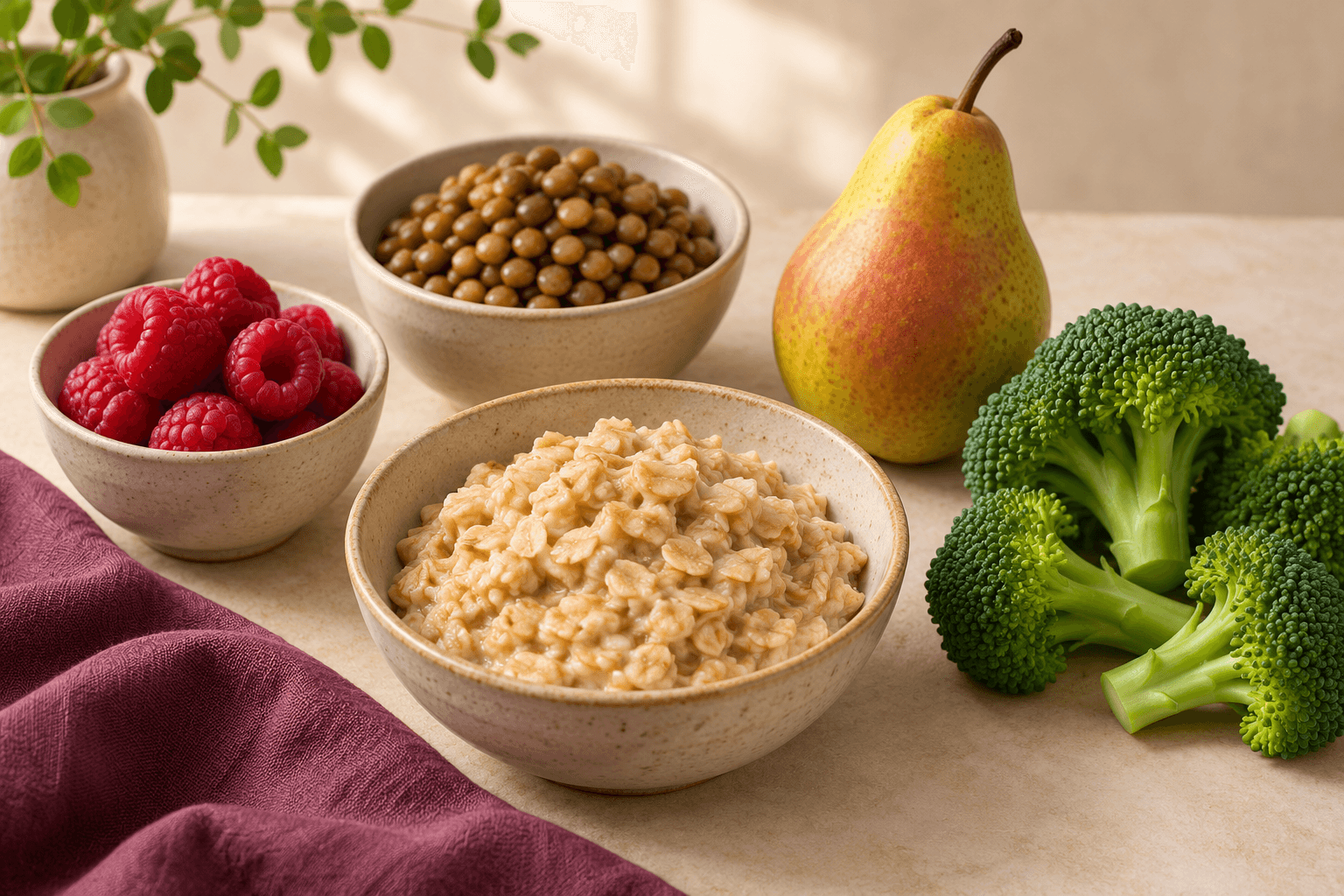
High fiber foods include beans, lentils, whole grains, fruit, vegetables and nuts. The useful question is how much fiber comes in the portion you actually eat. A food can sound fiber-rich while the amount on your plate is small, and a reference portion is not an instruction to finish it.
Use the chart below to compare eight familiar foods, then choose one change that fits an ordinary meal. You do not need to eat everything on the list or reach a new daily total overnight. If you have been prescribed a low-fiber diet, follow that plan and ask your care team before using a higher-fiber food chart.
What does “high fiber” mean on a food label?
The Nutrition Facts label lists dietary fiber in grams and as a percent Daily Value, or %DV. FDA uses 28 grams as the Daily Value for a 2,000-calorie diet. This is a reference for interpreting labels; it does not establish the right intake for every person or a treatment target for someone taking a weight-loss medicine. Individual needs and medical instructions still matter. FDA dietary fiber guide.
For packaged foods, FDA's general label-reading guide considers 20% DV or more per serving high and 5% DV or less low. Check the serving size first. Comparing a full cup of one cereal with half a cup of another can make the fiber numbers misleading. Also read calories, sodium and added sugars rather than choosing a food from its fiber number alone. FDA Nutrition Facts guide.
The current 2025–2030 Dietary Guidelines for Americans encourage a variety of vegetables and fruits and prioritize fiber-rich whole grains. That supports variety, rather than making a single food the center of every meal. Dietary Guidelines, pages 2–3.
Eight high fiber foods, with portions you can compare
These figures are from USDA's Food Sources of Fiber: Standard Portions, published in August 2024 using FoodData Central 2019 data. They are reference values, not measurements of your particular food or brand. USDA explicitly notes that its listed portions are not necessarily recommended serving sizes. The 2024 date describes this food table, not the edition of the current Dietary Guidelines. USDA food-source chart.
| Food | Reference portion | Fiber |
|---|---|---|
| Lentils, cooked | ½ cup | 7.8 g |
| Black beans, cooked | ½ cup | 7.5 g |
| Chickpeas, cooked | ½ cup | 6.3 g |
| Bulgur, cooked | ½ cup | 4.1 g |
| Raspberries | 1 cup | 8.0 g |
| Pear | 1 medium | 5.5 g |
| Broccoli, cooked | 1 cup | 5.2 g |
| Almonds | 1 ounce | 3.5 g |
These foods contribute different amounts of fiber; not every listed portion meets FDA's 20% DV guide for a high amount. The preparation matters: the grain and legumes are measured after cooking, not dry. The amounts describe the listed food, not a soup, smoothie or mixed dish containing it. For a packaged product, use its own Nutrition Facts panel and the amount you actually serve.
Notice how different the reference portions are. A cup of broccoli, a medium pear and an ounce of almonds are not equal amounts of food, equal calories or interchangeable meals. This is a practical fiber comparison, not a ranking of which food is “best.”
Turn the chart into a meal, not another rule
Start with something you already eat. For breakfast, berries could go alongside or into a food you enjoy. At lunch, cooked lentils or chickpeas could become part of a soup or salad. At dinner, cooked bulgur or broccoli could be a side. These are ways to use the foods, not fixed recipes or a complete meal plan.
Keep the rest of the meal in view. Adding a fiber-containing food does not tell you whether the meal supplies enough protein or fits your overall needs. If you use GLP-1 treatment and want to discuss that balance, ask your clinician or dietitian how it fits your usual meals and treatment plan.
A small calculation can help you use the table honestly. Half of the listed raspberry portion is ½ cup: approximately 4 grams of fiber, calculated as 8.0 ÷ 2. That is a scaled estimate from the reference, not a separately tested food value. It lets you compare your portion without assuming you must eat a full cup.
You can use the same approach when a package's serving size differs from yours: identify the labeled serving, identify what you ate, and adjust accordingly. Avoid counting the fiber twice when a prepared dish's label already includes its ingredients.
Increase gradually and make room for fluids
A higher fiber number is not a challenge to complete as quickly as possible. NIDDK advises adding fiber a little at a time so your body can adapt, and drinking liquids to help it work. It also recommends asking a health professional how much fluid fits your health, activity and circumstances. NIDDK nutrition guidance for constipation.
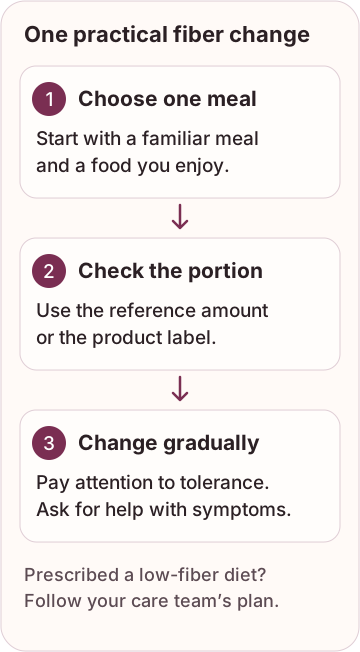
Try a simple sequence:
- Choose one familiar meal. Identify a food from the chart that you would realistically enjoy there.
- Check the portion. Use the reference or the product's label to estimate what that amount contributes.
- Pay attention to tolerance. Make changes gradually rather than adding several large portions at once. Ask for help if symptoms make eating or drinking difficult.
If constipation is part of the reason you are changing your food, the cause and symptoms deserve attention too. Our semaglutide and constipation guide separates general food measures from medication-specific questions. A food chart cannot decide whether a medicine or another condition needs review.
When more fiber is the wrong next step
Gastroparesis is an important exception to generic higher-fiber advice. NIDDK explains that a clinician may recommend low-fiber foods, smaller meals and particular textures for this condition. If you have gastroparesis or an existing low-fiber plan, ask your clinician or dietitian how to adapt meals; do not replace those instructions with this chart. NIDDK gastroparesis nutrition guidance.
Constipation with constant abdominal pain, vomiting, blood in the stool or an inability to pass gas needs medical attention right away. Do not respond by simply adding more beans, bran or a fiber supplement. NIDDK constipation warning signs.
Educational information, not an individual meal plan or medical advice. Food-source and guidance passages checked November 11, 2026.
Frequently Asked Questions
Which food in this chart has the most fiber?
Raspberries have 8.0 grams in the listed one-cup portion, compared with 7.8 grams in half a cup of cooked lentils. Those are different portions. Neither number establishes the best choice for you; taste, tolerance, cost and the rest of the meal matter too. The table is not an exhaustive list of fiber-containing foods.
Do high fiber foods automatically help me lose weight?
This chart does not predict weight loss. It shows fiber amounts, not the calories of an entire meal or what a food replaces. A large serving, added toppings or an extra snack can change the overall picture. Use fiber as one part of food planning rather than as a promise attached to a particular food.
Can I use the chart while taking a GLP-1 medicine?
It can help you prepare food questions, but it does not establish an appropriate fiber target or portion for your prescription, symptoms or medical history. If your appetite or food tolerance has changed, discuss that with your care team. Our practical meal checklist for semaglutide covers the broader meal-planning conversation.
Does a protein shake count as a high-fiber food?
Read its dietary-fiber line; the protein number does not answer that question. The values depend on the actual product and what you mix into it. If the shake replaces a meal or snack, compare the whole preparation. Our protein-powder guide explains that added-versus-replaced distinction.
Are canned or frozen foods an option?
The current Dietary Guidelines include frozen, dried or canned vegetables and fruit with no or very limited added sugars as possible choices. The fiber grams in a particular package may differ from this reference table. Read its label and preparation instructions, especially when the stated values apply to drained food or a prepared serving. Current Dietary Guidelines.
What should I bring to a nutrition appointment?
Bring your usual foods and approximate portions, the change you are considering, any symptoms, and your medicines and supplements. If tracking food feels unhelpful or distressing, describe your routine in words instead. Our guide to planning macronutrients can help you prepare questions about the rest of your meals.
Sources
This article is based on the following primary sources. Links open the original documents.
- 1.Dietary Fiber — Interactive Nutrition Facts Label · U.S. Food and Drug Administration · accessed
- 2.How to Understand and Use the Nutrition Facts Label · U.S. Food and Drug Administration · accessed
- 3.Dietary Guidelines for Americans, 2025–2030 · U.S. Department of Agriculture and U.S. Department of Health and Human Services · accessed
- 4.Food Sources of Fiber: Standard Portions — August 2024, FoodData Central 2019 · U.S. Department of Agriculture · accessed
- 5.Eating, Diet, & Nutrition for Constipation · NIDDK · accessed
- 6.Eating, Diet, & Nutrition for Gastroparesis · NIDDK · accessed
- 7.Symptoms & Causes of Constipation · NIDDK · accessed
Telehealth prescribing rules differ by state. Read the state-by-state guide.
Majesta Health articles are written against primary sources (FDA labeling, NIH and CDC publications, state statutes) and each one passes a documented compliance review before publication. Where an article cites external sources, they are listed at the end of that article so you can check them yourself. No article currently carries an individual physician review; when a physician reviews an article, that page will show the reviewer's name, NPI and review date.
- Written against primary sources: FDA labeling and safety communications, NIH and CDC publications, state statutes and medical board rules
- Documented compliance review against FDA, FTC and LegitScript requirements before publication
- External sources, where an article cites them, are listed at the end of that article with links to the original documents
- Compounded medications are described as not FDA-approved as final products on every page that mentions them